
History guide · Thu, Nov 12, 2026
The civil rights trail: a deeper King district and Sweet Auburn guide
Most visitors give the King district an hour. It deserves a day, and the neighborhood around it deserves the rest of that day: the National Historical Park done slowly (the Birth Home, historic Ebenezer, the King Center and its reflecting pool), then Sweet Auburn itself, the APEX Museum, the surviving business fabric of the avenue, and lunch where Black Atlanta has eaten for a century. Free at its core, with notes on the one tour and the one pass that are worth paying for, and a January section for MLK Day, Monday January 18, 2027.
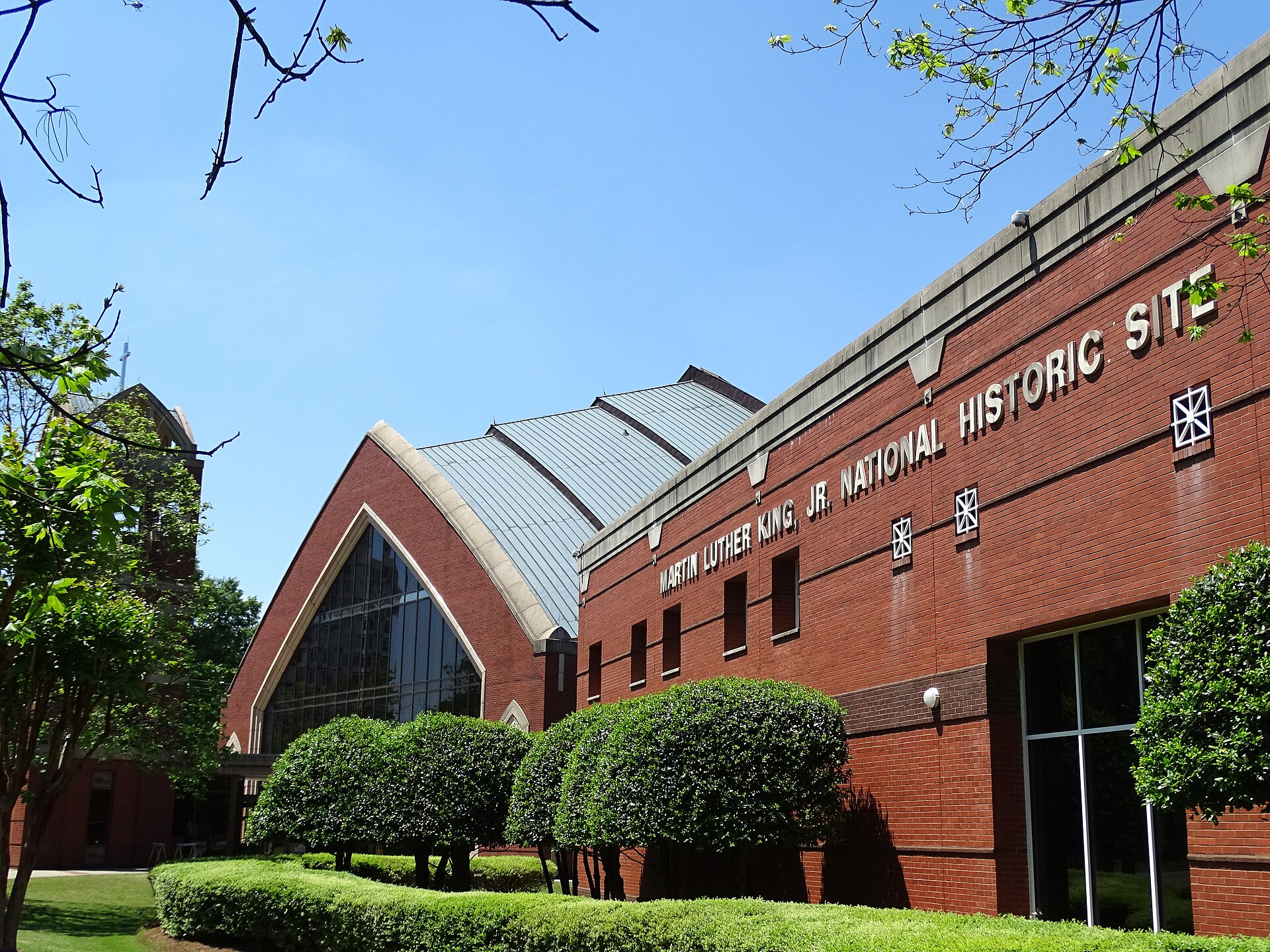
Every Atlanta itinerary touches the King district, and most touch it too lightly: a photograph at the Birth Home, twenty minutes in the church, and back downtown for lunch. Our 48 hours itinerary does that version, as one stop among many, and our best things to do list gives the district its paragraph. This guide is the other version. A few blocks of Auburn Avenue hold the full arc of Martin Luther King Jr.'s life, his birth, his church, his work and his grave, and around them the Black business district that raised him, much of it still standing. Give it a day, and let the neighborhood set the order. The core costs nothing: the park and the King Center are free, and this guide says so wherever money comes up.
Start at the visitor center, and claim the Birth Home first
The day should start at the park's visitor center at 450 Auburn Avenue NE, for one procedural reason: the Birth Home. Dr King was born at 501 Auburn Avenue, a few doors east, and spent his first twelve years in that house. It is open only on ranger led presentations, they are free, and places are capped at fifteen and claimed in person on the day, first come, first served. Arrive at opening, claim Birth Home places first, then settle into the exhibitions and film while you wait. One change to know, carried in our attraction record: the main visitor center is closed for renovation, and visitor services, including those tickets, currently run from the temporary visitor center in historic Fire Station No. 6 at 39 Boulevard NE. The park is open daily from 9am to 5pm, closed only on Thanksgiving Day, Christmas Day and New Year's Day, and parking is free in the lot off John Wesley Dobbs Avenue. King Memorial is the closest MARTA station.
Outside, slow down for the International Civil Rights Walk of Fame, its footsteps set into the pavement, and the "I Have a Dream" World Peace Rose Garden. Both set the register for the day.
Historic Ebenezer: the church as it was
At 407 Auburn Avenue stands the Ebenezer Baptist Church that matters to history: the Heritage Sanctuary, built in 1922, where King was baptised and where he served as co-pastor beside his father, Martin Luther King Sr., from 1960 until his assassination in 1968. His grandfather, the Reverend A. D. Williams, led the congregation before them: three generations of one family preached from this pulpit. The Park Service restored the sanctuary to its 1960s appearance, and the visit is a sitting one: take a pew, let the recorded sermons play, and look at the pulpit and the organ, where Alberta King, Dr King's mother, was shot and killed in 1974, a fact the room carries quietly.
Do not confuse it with the modern sanctuary across the street: the Horizon Sanctuary, opened in 1999, where Ebenezer's congregation worships today. It is a working church, not a museum; visitors attend it by attending a service. One building kept as it was, one alive and in use. Entry to the historic church is free.
The King Center: Freedom Hall and the reflecting pool
Across from the church at 449 Auburn Avenue is the Martin Luther King, Jr. Center for Nonviolent Social Change, the King Center, founded by Coretta Scott King in 1968, months after her husband's assassination, and still the institution that carries his work rather than only his memory. Its Freedom Hall holds exhibitions and artefacts from King's life.
The center of the complex is outside: the crypt of Dr King and Coretta Scott King, a white marble tomb raised in a long blue reflecting pool, with an eternal flame at its edge and Freedom Hall at the pool's east end. It is one of the genuinely quiet places in American public life, and it asks nothing of you but a few unhurried minutes. The King Center is free, as the park is; the two institutions are separate, one federal and one the King family's own foundation, and the day makes most sense when you treat them as the pair they are, the state keeping the ground and the family keeping the flame.
If you want the district narrated as you walk it, a guided history tour covers the park, the church, the King Center and the Birth Home with a local guide, and it is the one paid extra this guide recommends. The park is free either way; you are paying for the telling, not the entry:
Book the Martin Luther King Jr. History Walking Tourvia Viator · affiliate link
Sweet Auburn: the avenue that raised him
Keep walking Auburn Avenue, because the district's second story is the street itself. In King's childhood this was the commercial heart of Black Atlanta: John Wesley Dobbs, the neighborhood's unofficial mayor, named it Sweet Auburn, and in 1956 Fortune magazine called it the richest Negro street in the world. Segregation built it, by confining Black business to these blocks, and what got built was extraordinary: banks, insurers, newspapers, clubs, churches and shops, owned by the community they served.
Read the surviving fabric as you walk. The Atlanta Life Insurance Company, founded in 1905 by Alonzo Herndon, a man born into slavery who became Atlanta's first Black millionaire, kept its headquarters on the avenue. The Atlanta Daily World, founded in 1928, published here, the Royal Peacock Club hosted the rhythm and blues greats, and Wheat Street Baptist Church, founded in 1869, anchored the west end. Some of this is plaques and facades now: the interstate cut the neighborhood in the 1960s and desegregation, for all its justice, drew its customers away. But Sweet Auburn is not a ruin: businesses trade, congregations worship, and the preservation district around the park exists to keep the whole street standing.
The APEX Museum: the avenue tells its own story
At 135 Auburn Avenue NE, the APEX Museum does the thing the park cannot: it tells the story of Sweet Auburn itself, from inside it. APEX stands for African-American Panoramic Experience. Filmmaker Dan Moore Sr. founded it in 1978, which makes it Atlanta's oldest Black history museum, and its galleries run from Africa: The Untold Story and an exhibition on the Maafa, the African Holocaust, to Sweet Auburn: Street of Pride, the district's own history, with a replica of the Yates and Milton drugstore and a Trolley Theater where you sit in a replica streetcar and watch the avenue's story on film. Allow an hour to ninety minutes.
The APEX is the district's one ticketed interior: it opens Tuesday to Saturday only, 11am to 3pm, a short window that rewards planning around it rather than discovering it at 3.30pm. Admission is $12 for adults and $8 for seniors, students and veterans, with children aged 4 and under free, and tickets are sold only on the museum's own website or at the door; it no longer accepts third party tickets, so there is deliberately no booking button here.
Lunch where the neighborhood eats: the Curb Market
End the walk with food. The Municipal Market at 209 Edgewood Avenue, a few minutes south of the park, opened in its brick building in 1924 and is known to everyone in Atlanta as the Sweet Auburn Curb Market, a name with the district's history inside it: under segregation, Black vendors, barred from selling inside, traded from the curb outside, and the name stuck long after the rule fell. Inside today are some 28 independent businesses, butchers, produce stalls, a bakery and food counters serving soul food, Caribbean plates, arepas, burgers and burritos; several of Atlanta's best known small restaurant names started as stalls here. It is a working market, not a food themed attraction, and a plate lunch is a way of spending money in the neighborhood you came to honour. Check the day's hours first, as market hours are shorter than the park's.
Coming in January: MLK Day and the winter visit
This guide is evergreen, but its biggest day is ahead. Martin Luther King Jr. Day falls on Monday January 18, 2027, and the King district is where Atlanta keeps it: the King Center's King Holiday observance, services at Ebenezer, and the heaviest visitor day of the park's year. Come in January and three adjustments apply. Arrive before opening and claim Birth Home places first. Build the day around the park and the King Center, and let the APEX, closed on Mondays, fall on the Saturday or Tuesday instead. And expect the district to feel like a place of pilgrimage; take that as the point. The detailed January program is published by the Park Service and the King Center closer to the day; check both, and book the guided tour ahead, because its January dates go early.
January visitors usually pair the King district with downtown's ticketed civil rights museum, the National Center for Civil and Human Rights at Pemberton Place, and a pass makes that pairing pay. Atlanta CityPASS covers five attractions over nine days, and the National Center is one of its choice attractions, alongside the Georgia Aquarium and the World of Coca-Cola across the same plaza. At US$109.95 on this site's listing, it earns its money for a January trip that does the plaza as well as the avenue:
Get Atlanta CityPASSvia Klook · affiliate link
Where to stay for this district
Stay downtown. The King district sits a short ride east of the downtown hotel core, and a downtown base keeps the National Center, the plaza and the January events on the same simple map. Midtown is the alternative for the High Museum, a few stops north, but for a trip built on this trail, downtown is the honest answer:
Stay downtown, Friday 15 to Monday January 18, 2027via Booking.com · affiliate link
Walk it at the neighborhood's pace, and Auburn Avenue stops being a stop and becomes the trip. Check the Atlanta What's On events calendar for King Holiday week listings as January approaches, and set an alert so program announcements reach you before you travel.
More reading on the articles page, or go straight to the events calendar.